
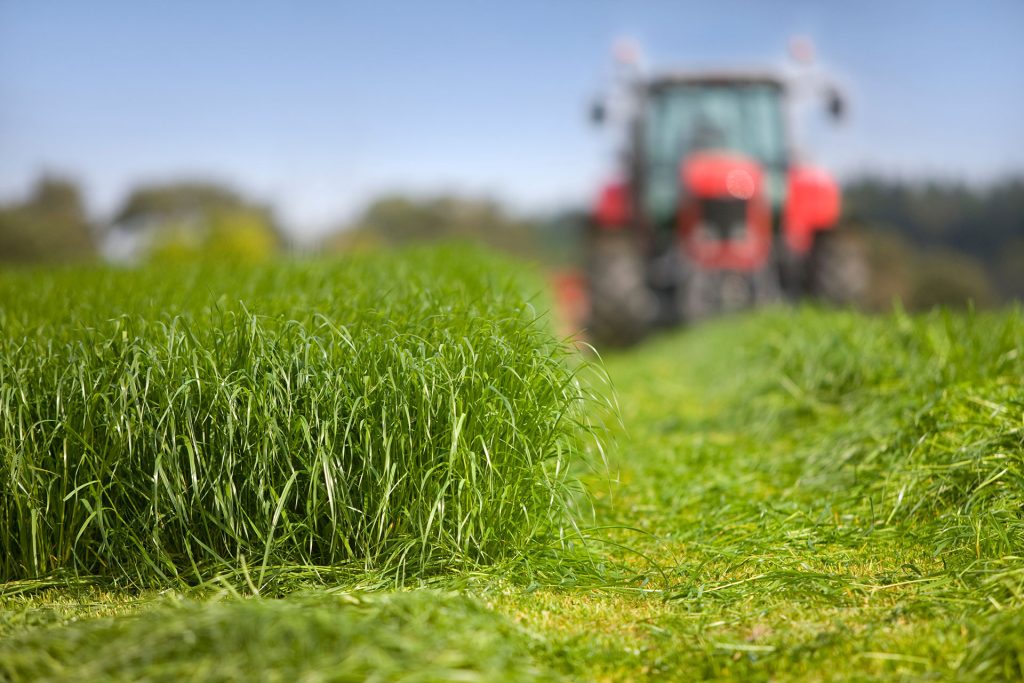
Fertilising 1st Cut Grass Silage
Producing high quality 1st cut grass silage starts with getting your nutrient management plan right. Silage crops have a large nutrient demand and adequate N, P, K & S is essential for maximising both grass quality and overall grass yield.
Nitrogen (N) is the driving force behind grass growth. It promotes leaf development, increases yield, and boosts the crude protein content of silage. Grass swards with a high proportion of perennial ryegrass have been proven to use nitrogen more efficiently than older swards. Newly reseeded swards (0–3 years old) have approximately 25% higher nitrogen demand, particularly when reseeded following a tillage rotation.
A grass silage crop yielding 5 t/ha of dry matter will require 100–125 kg N/ha (80–100 units/acre). Grass silage typically takes up about 2.5 kg N/ha/day (2 units/day), so nitrogen should be applied 40–50 days before cutting to ensure full utilisation. Adjust nitrogen applications based on your target cutting date. For example, a 40‑day growth interval requires approximately 80 units of nitrogen per acre (40 days × 2 units/day).
Phosphorus (P) plays a key role in energy metabolism and root development. It helps plants establish strong, healthy root systems and supports early growth, which is essential for producing a dense, leafy crop.
Potassium (K) is crucial for overall plant health. It regulates water movement, enhances stress tolerance, and improves stem strength. Potassium is particularly important for bulk in silage crops.
Both P and K are essential for maximising grass yields, so maintaining adequate soil levels is critical. Up‑to‑date soil test results should always guide the phosphorus and potassium requirements of a silage field. The crop’s needs for N, P, K, and S should be met through a planned & strategic combination of slurry and chemical fertiliser.
A grass silage crop typically removes approximately 4 kg of P and 25 kg of K per tonne of dry matter produced.
Organic Manures
Cattle slurry is the most commonly applied manure on silage fields, and its nutrient content can vary significantly depending on its dry matter (DM) content. Diluting slurry with water can make agitation easier and may improve nitrogen availability. However, dilution also reduces the concentration of phosphorus (P) and potassium (K), meaning larger volumes of diluted slurry are required to deliver the same nutrient levels as undiluted slurry.
A slurry hydrometer is a valuable tool for assessing slurry DM%. By estimating the dry matter content more accurately, you can better predict the nutrient value of the slurry and adjust application rates accordingly.
| Table 1: Available N, P & K values for cattle & pig slurry applied by LESS | |||
| Available N, P & K (units/1,000 gals) | |||
| Manure type | N | P | K |
| Cattle slurry (6% DM) | 9 | 5 | 32 |
| Dilute cattle slurry (4% DM) | 6 | 3 | 21 |
| Pig slurry (4% DM) | 19 | 7 | 20 |
Maximum K Application: 100 kg K/ha (spring)
Grass can take up luxury levels of potassium (K) when more than 100 kg/ha is applied in spring especially over a short period of time. This reduces fertiliser efficiency and may disturb the K:Mg:Na balance in the herbage. Where recommendations exceed 100 kg/ha of K, apply only 100 kg/ha in spring and apply the remaining K to the aftermath or in late autumn.
Table 2 outlines the recommended rates of nitrogen (N), phosphorus (P), and potassium (K) required to produce 5 t/ha of grass dry matter (equivalent to 10 tonnes of fresh grass per acre) across soil P and K Indexes 1 to 4.
| Table 2:- 1st Cut Grass Silage N, P & K Requirements (5t/ha DM) &
Suggested Fertiliser Programmes |
|||||
| Soil Index | N kg/ha (units/ac) | P kg/ha (units/ac) | K kg/ha (units/ac) | Suggested Fertiliser Options3,4 | |
| No Slurry1,4
(bags/ac) |
+ Cattle Slurry 4,5 (@2,500gal/ac) | ||||
| 11 | 100-125 (80-100) | 40 (32) | 175 (140) | 3.5 bags/ac 13-6-20
0.9bags/ac ProUrea+S |
1.4 bags/ac
ProUrea + S |
| 21 | 100-125 (80-100) | 30 (24) | 155 (120) | 3.5 bags/ac 13-6-20
0.9bags/ac ProUrea+S |
1.4 bags/ac
ProUrea + S |
| 3 | 100-125 (80-100) | 20 (16) | 125 (100) | 3.0 bags/ac 13-5-20+S
1.1bags/ac ProUrea+S |
1.4 bags/ac
ProUrea + S |
| 42 | 100-125 (80-100) | 0 | 0 | 2.1 bags/ac ProUrea+S | No Slurry P & K required at index 4 (P&K)
2.1 bags/ac ProUrea+S |
| 1Index 1, 2 & 3 soils apply P & K balance to build / maintain soil P & K levels to after grass for example apply as 18-6-12 / 0-7-30 / Cattle slurry / etc…
2Index 4 soils omit P for 2/3 years & retest, Index 4 K omit for 1 year and revert to index 3 advice thereafter until next soil test. Avoid applying cattle slurry on Index 4 soils. 3For reseeded / older swards with higher / lower yield potential increase/ reduce N, P, K by 25 kg N, 4kgP & 25kg K per tonne of grass dry matter (DM). 4 Protected Urea + S = Protected Urea (Urea 38% N + 7.5% S) 5Cattle slurry (6.3% DM) assumed to be applied by low emission techniques (LESS) – Slurry N-P-K equivalent to a 50kg bag of = 9-5-32 fertilizer |
|||||
Timing of N, P, K and S Application
Apply the full crop requirement of nitrogen (N), phosphorus (P), potassium (K) and sulphur (S) when closing silage fields. In wetter soil conditions, nitrogen can be split to improve efficiency and reduce losses—for example, apply 50% at the end of March and the remaining 50% 7–10 days later.
Don’t Forget Sulphur (S)!
Sulphur is essential for protein formation and for ensuring nitrogen works efficiently. When sulphur is deficient, crude protein levels fall and nitrogen efficiency declines—resulting in reduced N efficiency in the crop and reduced protein content in the feed. Sulphur deficiency is most common on light, sandy or free‑draining soils with low organic matter.
Grass silage crops require approximately 20 kg S/ha (16 units/acre) per cut. Applying sulphur to silage crops will improve dry matter yields and overall forage quality by helping to maintain an optimal N:S ratio, allowing applied nitrogen to be used more effectively.
Apply sulphur alongside the main nitrogen application as an N + S fertiliser (e.g. CAN + S, Protected Urea + S or compound +S).